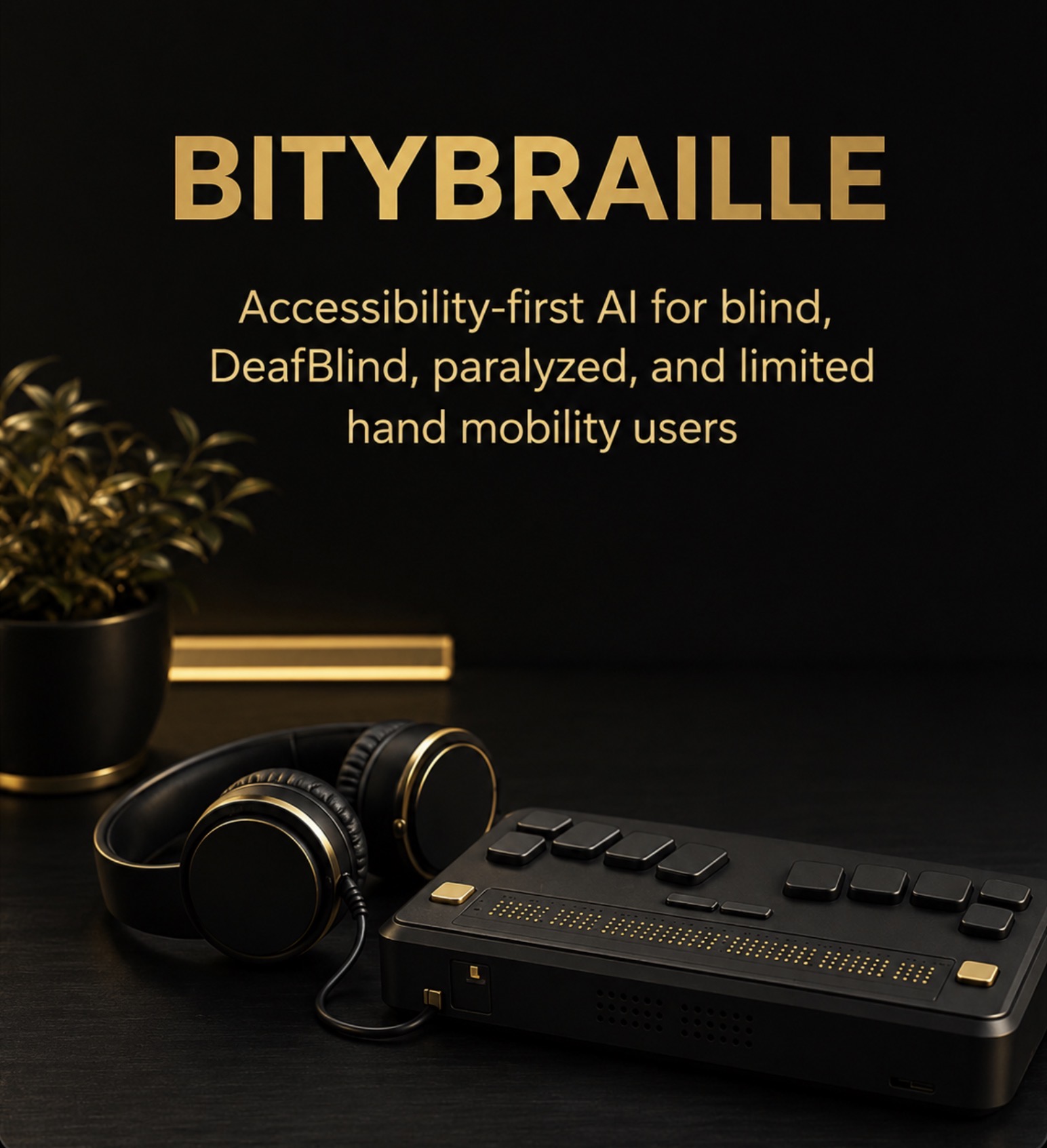
BITYBRAILLE
Accessibility-first AI interface for blind, DeafBlind, paralyzed, and limited hand mobility users
Executive Summary
BityBraille is an accessibility-first AI platform designed to help blind, DeafBlind, paralyzed, and limited hand mobility users interact with computers and artificial intelligence more independently. It combines braille, audio, and voice interaction into a single system so users can communicate with AI without depending on traditional screens, keyboards, or touch-based controls.
The Problem
- Standard screens and keyboards are not naturally accessible.
- Existing braille displays are often too expensive.
- Most AI tools are not designed around braille-first interaction.
- Many users with paralysis or limited hand mobility need hands-free access to digital systems.
The Solution
BityBraille provides a unified accessibility interface built around text input, voice input, braille conversion, audio playback, and hands-free interaction. It is designed not only for blind and DeafBlind individuals, but also for paralyzed users and people with limited hand mobility who need speech-driven access to AI.
How It Works
- User enters text or speaks a prompt.
- The system processes the request through AI.
- Content can be converted into braille output.
- The response can be spoken back through audio.
- Hands-free interaction supports paralyzed users and users with limited hand mobility.
Why It Matters
BityBraille is built to reduce barriers to AI access and improve digital independence across multiple accessibility needs. By combining braille, voice, and audio in one interface, it opens a path for blind, DeafBlind, paralyzed, and limited mobility users to participate more fully in the future of artificial intelligence.